The rectangular 9 V battery with the distinctive snap terminals is one of the oldest formats still in mass use, found in multimeters, smoke alarms, wireless transmitters, guitar pedals, medical sensors and countless toys. It is also one of the most misunderstood, because the same familiar shell hides four completely different chemistries with very different voltages, capacities and self-discharge behaviour. Buyers repeatedly ask how long a 9 V battery 'really' lasts, whether a rechargeable 9 V is a direct replacement, and whether NiMH can go into a smoke detector. This guide opens the block, compares the chemistries on a like-for-like basis and gives clear application guidance - including the important safety case where a rechargeable 9 V should not be used.
The 9 V format is defined by its housing and snap contacts rather than by a single chemistry. The common primary (non-rechargeable) versions are the alkaline 6LR61 (ANSI 1604/1604A, also sold as MN1604 or PP3) and the older zinc-carbon 6F22, while premium primaries use lithium iron-disulphide (Li-FeS2) chemistry. The standard rechargeable version is the NiMH 6HR61, with rechargeable lithium 9 V blocks also appearing with internal protection circuitry.
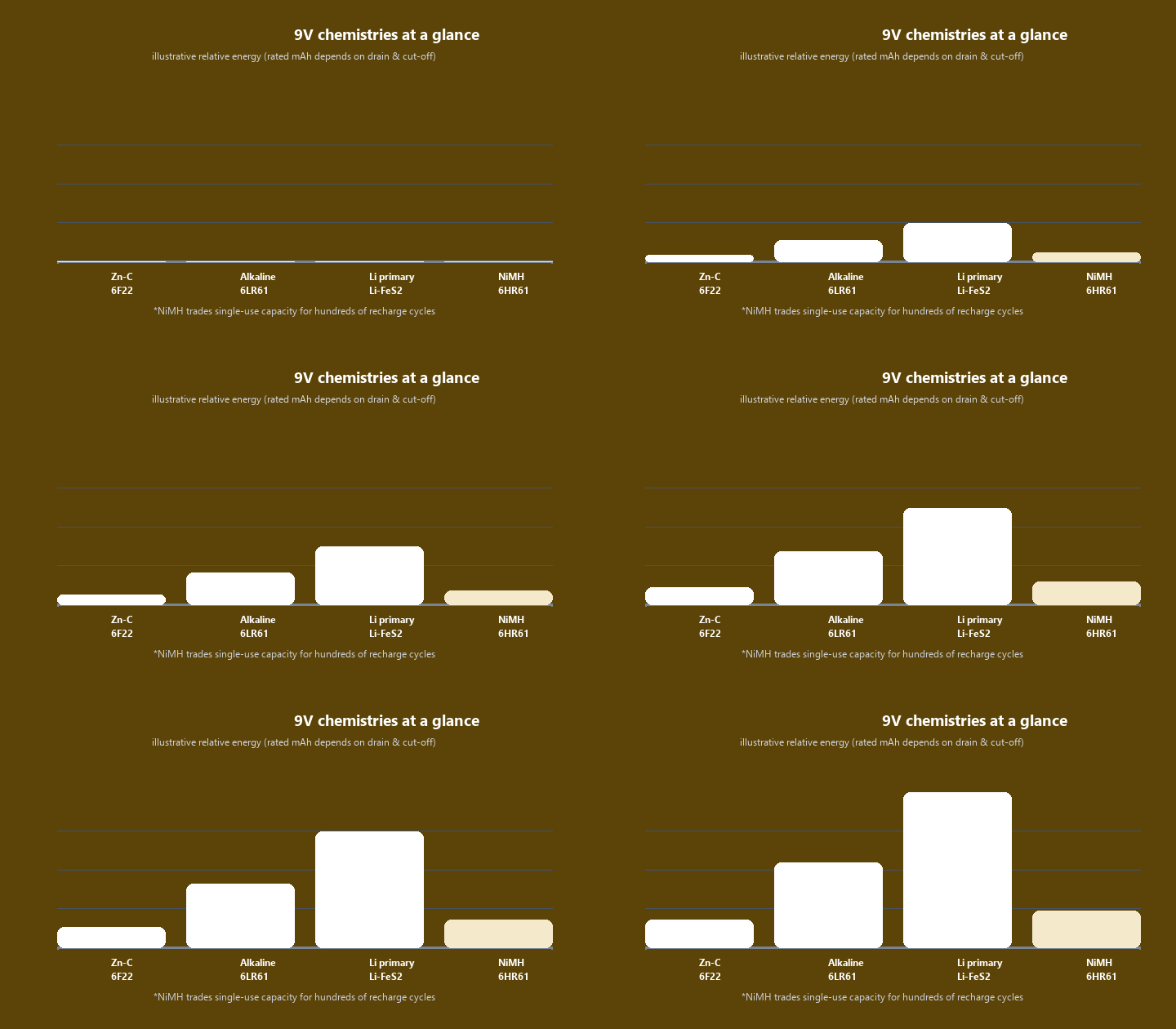
They are not equal. A zinc-carbon 6F22 is a low-cost, low-energy cell intended for very light or occasional drain. A modern alkaline 6LR61 stores substantially more energy and is the default general-purpose choice. A lithium primary 9 V combines high capacity with a decade-scale shelf life and strong pulse capability at a price premium. The NiMH 6HR61 trades some capacity and nominal voltage for hundreds of recharge cycles.
Because published capacity depends heavily on the test current and end voltage, comparing mAh numbers across brands without the test conditions is misleading. Professional datasheets state the drain and cut-off: Duracell's industrial Procell PC1604, for example, rates about 726 mAh under a continuous 2 mA load to a 5 V cut-off, while other alkaline 9 V lines sit around the high-500 to low-600 mAh range under their own conditions. Rechargeable NiMH 9 V blocks typically land in a lower range, commonly roughly 150-300 mAh, because of how they are built.
A primary 9 V reaches its voltage by wiring six small cells in series: six times roughly 1.5 V gives the 9 V nominal of the alkaline 6LR61 (the '6' in the designation denotes six series cells). Open one and you find six tiny cylindrical or stacked cells, welded to a contact board that feeds the male and female snap terminals.
A NiMH cell is nominally 1.2 V, so seven cells in series produce the common rechargeable 9 V block at 8.4 V nominal; a few designs use eight cells for 9.6 V. That is the first fact to internalise: a fully charged NiMH 9 V does not present 9 V, it presents about 8.4 V (a little higher straight off the charger). Most equipment tolerates this, since devices regulate internally or are designed to accept a battery that sags well below 9 V as it discharges, but voltage-sensitive gear should be checked.
The second fact is mechanical. Seven NiMH cells already fill the block, and each is very small, so there is little room for active material. The result is a pack with modest capacity and higher internal resistance than, say, an AA NiMH cell. Rechargeable 9 V blocks are therefore best understood as convenience and lifecycle products for moderate, repeated use rather than as energy-density champions.
The economic case for a rechargeable 9 V is the same as for any NiMH product: it is not about one-cycle capacity, it is about energy delivered across hundreds of cycles and the elimination of repeated purchases and disposal. A multimeter used daily, a teaching lab, a studio full of wireless gear, a workshop with test instruments or a household that cycles 9 V cells through several devices will typically amortise a NiMH 9 V and its charger quickly, while avoiding dead primaries in the drawer.
Self-discharge is the specification that separates good 9 V NiMH from poor. Conventional NiMH loses a noticeable fraction of its charge each month, which is harmless when the pack returns to a charger after every job but makes it a poor 'grab and forget' cell. Low-self-discharge (LSD) NiMH chemistry holds most of its charge for many months on the shelf and is the preferred construction for rechargeable 9 V blocks that may sit between uses.
Charging must match the pack. A 7-cell NiMH 9 V requires a charger designed for the 8.4 V series count and for NiMH termination (-dV/dt, plateau or temperature), never a generic charger intended for a different chemistry or cell count; an 8-cell 9.6 V pack is not interchangeable on a 7-cell charger. Using the matched charger is what unlocks the rated cycle life and keeps the small cells inside their thermal limits.
A 9 V battery's delivered capacity is unusually load-dependent. The internal cells are small, so their voltage sags under high current and effective capacity drops quickly as drain rises. This is why an alkaline 9 V can post several hundred mAh on a gentle 2 mA instrument load yet deplete far faster in a high-drain motorised toy or a loud wireless transmitter, and why the lightweight NiMH block - with still-higher internal resistance - is most competitive at light to moderate currents.
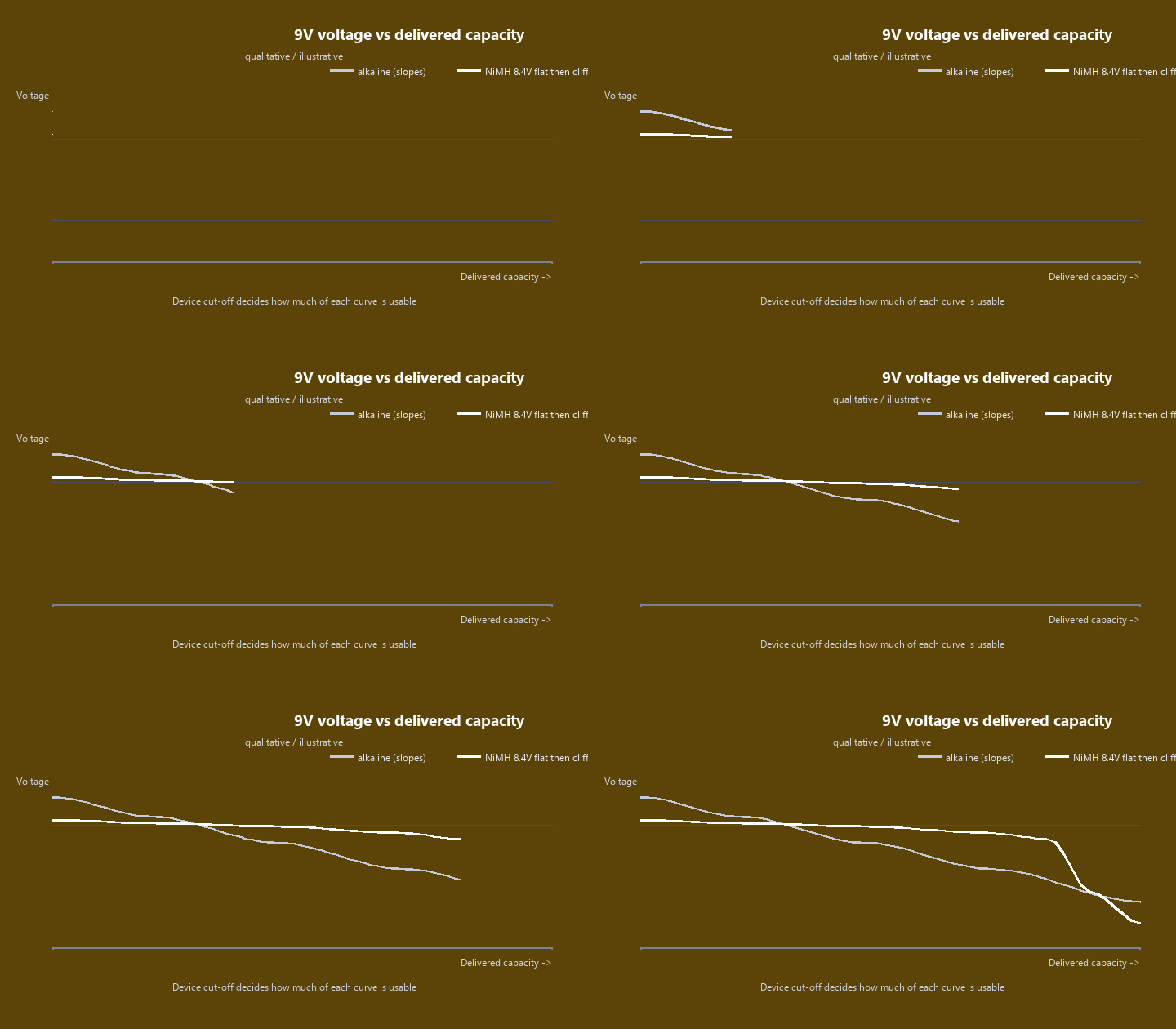
The discharge curves also differ in shape. An alkaline 9 V starts high and slopes downward toward the device cut-off; a NiMH 9 V holds close to 8.4 V across most of its useful life and then drops sharply, the classic flat NiMH plateau; a lithium primary stays high and flat for a very long run. Equipment that regulates from 9 V down to a low cut-off voltage uses far more of every chemistry than a device that warns early.
When sizing a 9 V application, the defensible method is to test at the actual standby and active currents to the actual shut-down voltage, and to size on energy (mWh) rather than the mAh number alone, because the nominal voltages differ (9 V versus 8.4 V). A pack specified on measured duty will always outperform one chosen from a headline figure.
Rechargeable 9 V NiMH is an excellent fit for frequently used, moderate-drain devices where the pack returns to a known charger: bench multimeters and clamp meters, wireless handhelds and instrument packs that accept the lower voltage, guitar wireless, small radios and receivers, hobby transmitters, training and educational equipment, and sensors that are serviced on a schedule. In these roles it cuts consumable cost, removes leak risk and aligns with the direction of the EU Battery Regulation 2023/1542, which favours removable, rechargeable and ultimately more circular portable batteries.
It must not be used as a like-for-like substitute in long-life safety standby without verification. Residential smoke alarms are built to standards such as EN 14604 in Europe and UL 217 in the United States and are expected to sit unattended for months or years drawing a tiny standby current before sounding a loud, high-current alarm. Most alarm manufacturers specify fresh alkaline or long-life lithium primaries precisely because primaries have very low self-discharge and a high initial voltage, whereas a standard NiMH block can self-discharge flat between service visits and starts from only 8.4 V. Always follow the alarm's manual; where a device explicitly lists NiMH and provides a suitable charging or servicing regime it may be acceptable, but an unmodified years-long standby alarm is not a place to improvise a rechargeable.
The same logic applies to other life-safety or emergency-standby devices: choose the chemistry the manufacturer certifies for the standby duration, and reserve NiMH for duties where it is genuinely recharged and maintained.
For OEMs and distributors, a credible 9 V NiMH line means specifying the series count (7-cell 8.4 V is the mainstream), realistic capacity at a stated drain and cut-off, internal resistance, self-discharge (LSD preferred for retail shelf life), cycle life and the snap-terminal and housing dimensions that guarantee drop-in fit. Welded internal connections, a proper charge path, correct polarity keying and consistent shrink labelling all matter in such a compact pack.
Documentation should follow the NiMH and battery-safety framework: IEC 61951-2 for sealed NiMH performance, IEC 62133-1 for safety, and UN 38.3 / IEC 62281 for transport, with regional marks as required. Suppliers should be able to provide capacity and charge-retention data measured to a stated condition rather than a single optimistic number, and to co-validate a matched charger.
Specified honestly - with the 8.4 V voltage, the modest capacity and the standby limitations stated up front - the rechargeable 9 V is a professional, repeatable product for the right devices rather than an over-promised universal replacement.
Weijiang Power supplies sealed nickel-metal hydride cells and matched packs for consumer and professional products - high-drain AA and AAA cells for wireless audio, low-self-discharge 9 V (6HR61) blocks, and tabbed Sub-C cells welded into cordless-tool, appliance and RC packs. We support OEM, ODM and private-label partners with IEC 61951-2 performance files, IEC 62133-1 safety evidence, UN 38.3 / IEC 62281 transport documentation, pulse-load and capacity matching, and charger/pack co-validation. Tell us your duty cycle, peak current, cell or pack format, autonomy target and the standards your product must meet, and our engineers will specify a matched cell-and-pack combination. Review the range on the products page.


