Paper A of this series established that airborne emergency electrical power is a tiered system - engine and APU generators, the ram air turbine (RAT), the main ship batteries and a distributed set of dedicated emergency battery power supplies (EBPS) - and it mapped the two-phase load profile the chemistry sees: a short starting pulse followed by a long, low sustained draw on the essential buses. This Paper B, the selection and sizing instalment, turns that operating regime into a procedure an engineer can actually follow for the dedicated emergency-lighting and critical-equipment supply. The sequence is deliberate: enumerate the loads before choosing a cell, build the power budget and convert it to a current profile, choose the chemistry for the role, set the series cell count and voltage window so the bus never falls below equipment cut-off, size the capacity with cold, end-of-life and pulse deratings, and only then design the charge control and thermal path. The whole procedure is anchored to a hard regulatory floor - 14 CFR 25.812(i), which requires the energy supply to each emergency lighting unit to deliver the required illumination for at least 10 minutes at the critical ambient conditions after an emergency landing - and to a concrete certified class of product, the nickel-metal hydride (NiMH) emergency battery power supplies certified to TSO-C173a, RTCA DO-293A and RTCA DO-160G that directly replace legacy nickel-cadmium (NiCad) units. As in Paper A, the boundary should be stated plainly: this is the selection method for the long-stowage emergency-lighting and critical-equipment supply, not for the high-current engine-starting ship battery.
The most common sizing error is to begin with a familiar catalogue cell and then assume it will be "enough." A defensible design begins instead with a complete list of every load the supply is required to keep alive in the emergency configuration. For a dedicated emergency supply that list is drawn from the emergency lighting system defined in 14 CFR 25.812: illuminated emergency exit locating and marking signs, the sources of general cabin illumination, interior lighting in the exit areas, floor-proximity escape path marking and the exterior emergency lighting that covers the wing and the ground where an evacuee first steps, together with any critical equipment the particular installation assigns to that supply rather than to the main battery. Two discipline points follow. First, in an emergency all of these lights are energised simultaneously for the entire event, so unlike a comfort-load panel there is no diversity or coincidence factor to credit - the loads are summed at their worst-case value. Second, the engineer must hold two endurance numbers in mind and not confuse them: the regulatory floor of at least 10 minutes at the critical ambient conditions, which is a pass-or-fail minimum rather than a design target, and the operational endurance the operator actually wants, which for a cabin and critical-equipment supply is generally specified well beyond the floor to cover prolonged scenarios. The "critical ambient conditions" phrase matters: the 10 minutes must be available in the worst-case temperature the installation defines, which for an aqueous chemistry is dominated by cold-soak. The same regulation shapes the surrounding design: the control must provide on, off and armed positions, the lights must be operable from the flight station and a flight attendant station, and where storage batteries are used they may be recharged from the aircraft power system provided the charging circuit cannot discharge into a fault.
Once the loads are listed, each is reduced to a power figure in watts - for an electrical load, watts equal volts times amps - and the figures are summed into a total P. Dividing that total by the nominal supply voltage gives the sustained current the pack must deliver: for a nominal 24 V supply, I = P / 24. The worked table below gives an illustrative load list for a small cabin; the numbers are round and qualitative, but the summation method is the one used in a real budget. It produces about 24 W, or roughly 1 A sustained at 24 V.
Illustrative emergency-supply load list (small cabin; qualitative)
| Load group | Illustrative power |
|---|---|
| Illuminated exit signs and locators | 6 W |
| General cabin / aisle illumination (LED) | 8 W |
| Floor-proximity escape path marking | 4 W |
| Exterior exit lighting | 3 W |
| Critical equipment / control electronics | 3 W |
| Total (P) | ~24 W → ~1 A at 24 V |
The sustained current, however, is only one of the two numbers the pack must be sized against. At the moment the emergency configuration is established, contactors close, driver and inverter input capacitors charge and cold lamps or LED drivers present an inrush that can briefly be several times the running current. The supply must ride through that pulse without its terminal voltage collapsing below the equipment cut-off, and it must then settle into the steady draw. Sizing the pack against the single average current and ignoring the starting pulse is precisely the failure Paper A warned against; the budget therefore records both the sustained current and the magnitude and duration of the inrush.
Four chemistries appear across the airborne emergency system, and the dedicated lighting supply should be chosen on the demands of its specific duty - long quiet stowage at full readiness, a short starting pulse and a reliable low sustained draw - rather than on fashion. Vented NiCad is the incumbent on many aircraft and is mechanically robust with high short-duration current, but it carries memory effect, requires water top-up and cell balancing and calls for frequent deep capacity checks. Valve-regulated lead-acid is simple and forgiving but heavy, with lower cycle life and a tendency to sulphate during long stowage. Certified rechargeable lithium offers the highest energy and power density, but because it introduces thermal-runaway behaviour the aqueous chemistries do not, it is governed by RTCA DO-311 and DO-311A, authorised under TSO-C179 and installed under the guidance of AC 20-184A, with special conditions and extensive cell, module and system-level thermal testing; the 2013 events on the Boeing 787 show why that oversight exists. Sealed NiMH uses an aqueous, non-flammable potassium-hydroxide electrolyte, so it does not exhibit lithium-style thermal runaway, while eliminating the memory effect and water maintenance of the NiCad units it replaces; in the certified emergency-supply class its capacity check is required only every two years, and it behaves well in the cold. The comparison is summarised below; the conclusion is role-specific rather than absolute.
| Attribute | Vented NiCad | Lead-acid | Certified lithium | Sealed NiMH |
|---|---|---|---|---|
| Routine maintenance | Water top-up, balance | Minimal | Minimal | None (sealed) |
| Memory effect | Yes | Some | No | Eliminated |
| Lithium-style thermal runaway | No | No | Managed; special conditions | No (aqueous) |
| Capacity-check interval | Frequent | Periodic | Per program | Every 2 years |
| Cold behavior | Good | Poor | Good (managed) | Good |
| Best role here | High-current ship battery | Simple backup | Weight-critical, with oversight | Lighting / critical supply |
For a dedicated, long-stowage emergency-lighting and critical-equipment supply, certified NiMH therefore offers the strongest balance of safety, low maintenance and cold behavior as a direct NiCad replacement. Certified lithium remains the right choice where energy density and weight dominate and the operator accepts the additional oversight; the high-current engine-starting role still belongs to vented NiCad and, increasingly, to certified lithium.
With the chemistry chosen, the next decision is the number of series cells, and the governing constraint is the equipment low-voltage cut-off: the supply terminal voltage must remain above that cut-off, with margin, for the entire endurance - including immediately after the cold starting pulse, when internal resistance pulls the bus lowest. A sealed NiMH cell has a nominal voltage of 1.2 V, so a nominal 24 V output is built from roughly 20 series cells (20 x 1.2 = 24 V); the certified class reflects this, with the TS56 providing a 24.6 V nominal output. The voltage window around that nominal must be understood cell by cell: a fully charged NiMH cell rests near 1.4-1.5 V open circuit, while the end-of-discharge voltage is on the order of 1.0-1.1 V per cell. Across 20 cells the end-of-discharge pack voltage therefore sits around 20-22 V, and the cell count is chosen so that even at that point, in the cold and after the inrush sag, the bus still clears the equipment cut-off rather than meeting it exactly. Two configuration cautions follow. Paralleling mismatched strings invites current sharing and balance problems; where the capacity requires more than a single series string, the cells must be closely matched and the strings assembled with equalisation in mind, and a well-sized single series string is generally preferred for a low-current supply. The charge input range must also match the aircraft bus - the certified TS56 accepts a 20-30 VDC input - so the supply can be maintained at readiness from the very network it backs up.
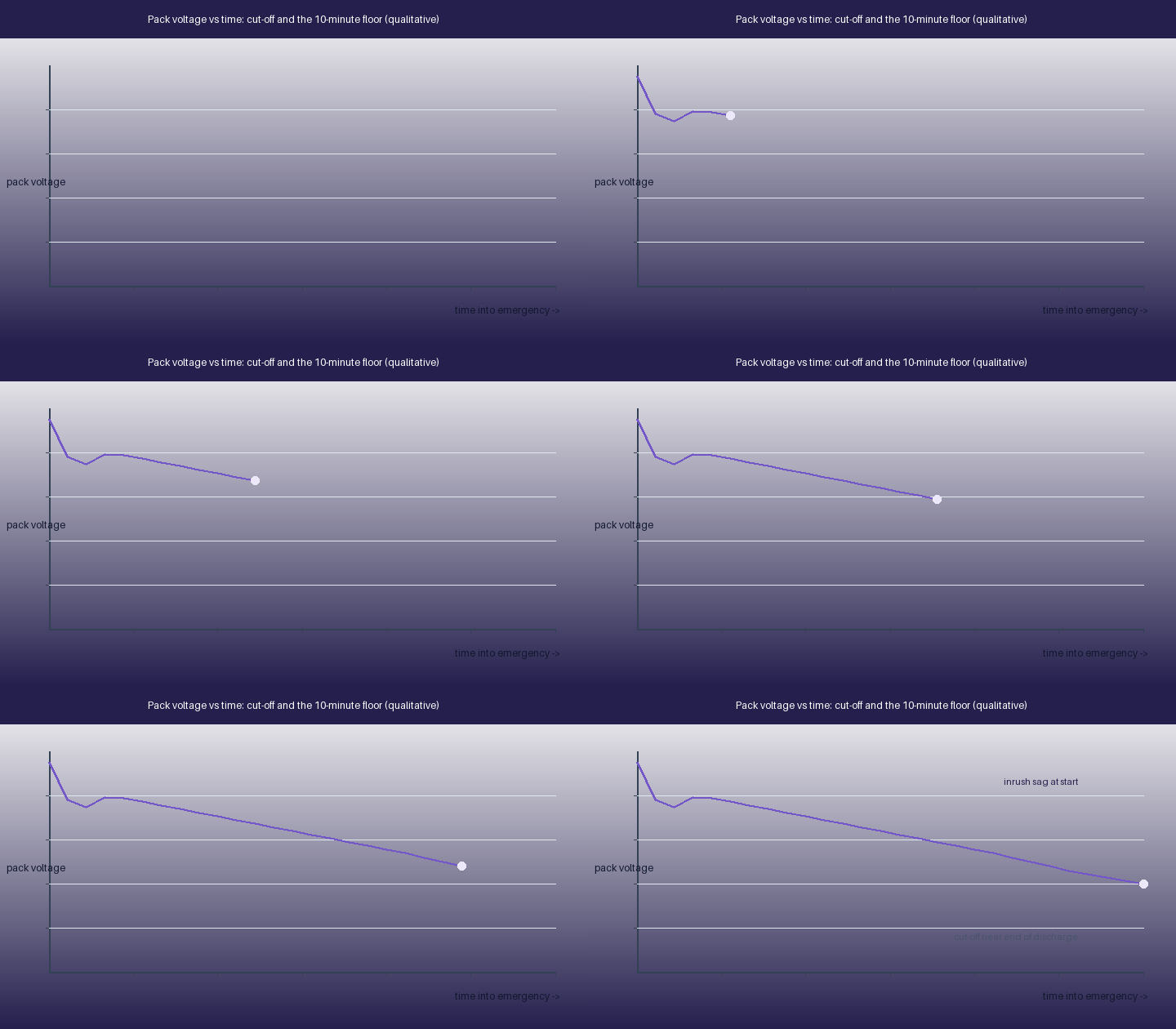
Capacity sizing converts the current profile and required endurance into a nameplate ampere-hour figure, and the essential discipline is that the nameplate rating is not the usable capacity in service. The required usable energy is P times t, and the nameplate capacity is set by grossing the sustained-current demand up through a stack of deratings: nameplate Ah = (I_sustained x t) / (f_cold x f_EOL x f_usable). Each factor has a physical basis. Cold reduces the capacity a cell can deliver and raises its internal resistance, deepening the voltage sag under the pulse; end-of-life capacity fade means the pack must still meet the requirement after years of service rather than only when new; and not every nameplate ampere-hour is usable above the equipment cut-off. Independently of the energy sum, the designer verifies that the worst-case starting pulse does not pull the terminal voltage below cut-off, since a pack with ample total energy can still fail at the first second if its voltage collapses. The table below works the illustrative 1 A cabin case through this method; the derating is a round, qualitative figure, while the certified product figures are included as a cross-check.
Illustrative capacity sizing at 1 A sustained (qualitative derating)
| Design endurance (well above the 10-minute floor) | 120 min (2 h) |
| Required usable Ah = I x t | 1.0 x 2 = 2.0 Ah |
| Combined cold x EOL x usable derating (illustrative) | ~0.70 |
| Required nameplate Ah | ~2.0 / 0.70 = 2.85 Ah |
| Certified cross-check: TS56 (~56 Wh at 24.6 V) | ~2.3 Ah; ~132 min at 1 A |
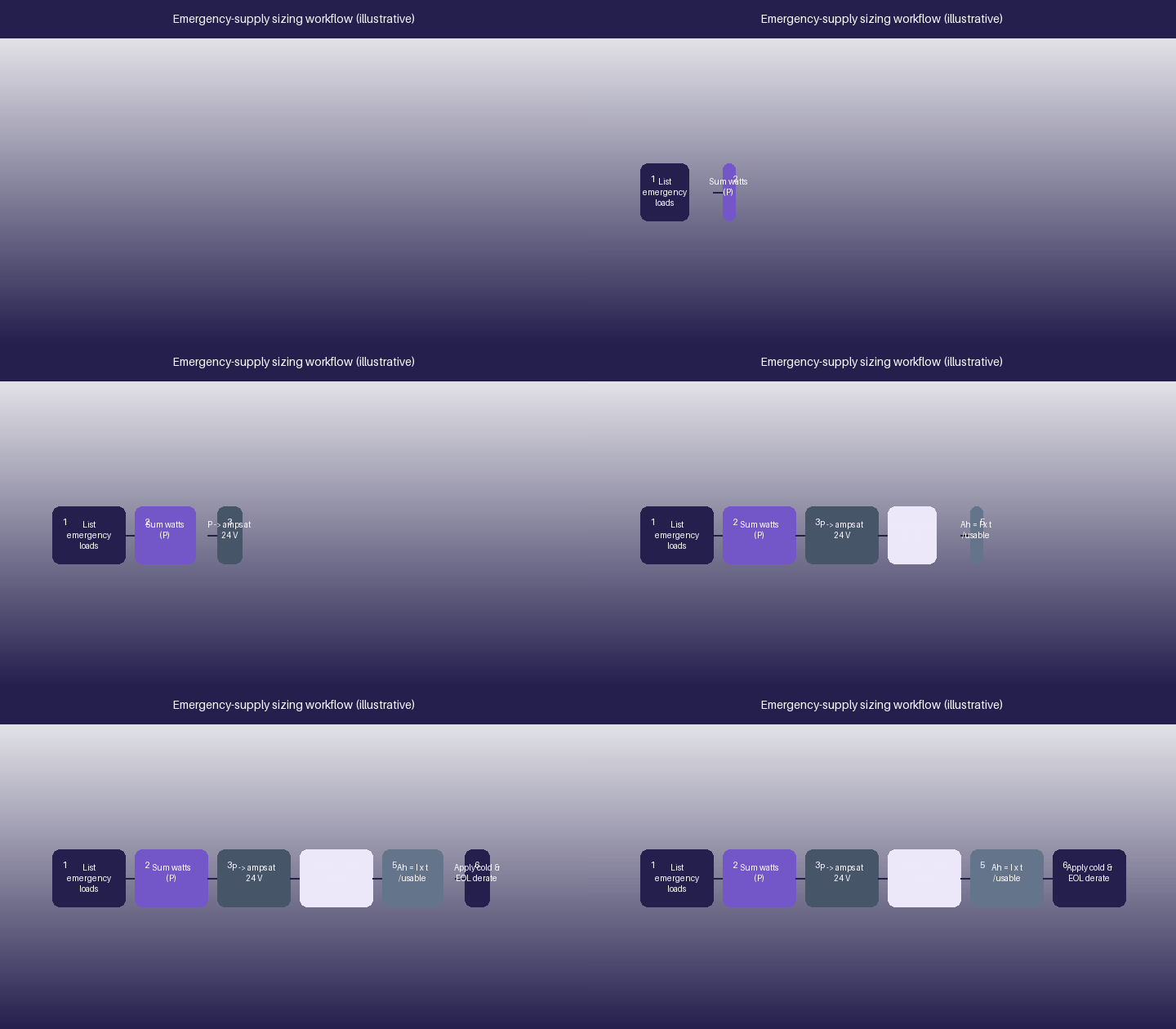
The cross-check is reassuring rather than coincidental: the certified TS56, at about 56 Wh and 24.6 V (roughly 2.3 Ah), delivers on the order of 132 minutes at a 1 A discharge, which brackets the illustrative requirement and carries its own qualified margins. The decisive regulatory point is the floor, not the target: even after the cold and end-of-life deratings, the pack must sustain the required illumination for at least 10 minutes at the critical ambient conditions, and a sound design shows that floor met with clear margin rather than approached at the edge. The first animated figure below summarises the full sizing workflow, from the load list through the derated ampere-hour figure.
An emergency supply spends almost its entire life waiting, so the charge and thermal design determines whether it is genuinely at full readiness when called. Under 14 CFR 25.812(j), the pack may be recharged from the aircraft power system only through a circuit that precludes inadvertent discharge into a charging-circuit fault, so the standby path is arranged to hold charge rather than feed a failure. In service the pack is maintained by a controlled charge regime - constant-current charging terminated on negative delta-V (-dV/dt), with a delta-temperature-over-time (dT/dt) backup and an absolute temperature cut-off - rather than by an uncontrolled float that could overcharge. Because NiMH charge acceptance falls sharply at low temperature, charging is confined to a defined temperature window and is never forced in cold conditions, where forcing charge would stress the cells without storing useful energy. The thermal and pressure design follows the airborne environment defined in RTCA DO-160: heat is conducted away from the cells through defined paths and spacing, and the enclosure provides pressure-relief and venting routes that work at altitude and under abuse without drying the cells out. The aqueous chemistry removes the lithium-style propagation hazard, but the pack still requires protection against short circuit and overcharge and a defined relief path; these provisions are specified as much for the installed environment as for cycle life.
Most emergency-supply projects are replacements for a legacy NiCad unit, and a successful replacement matches the original on every interface rather than only on voltage: the enclosure envelope and mounting, the connector and pin-out, the charge input range, the output and current capability, and the armed/on/off logic and warning behaviour. The certified NiMH TS32 (32 Wh) and TS56 (56 Wh) supplies are defined as direct replacements for legacy NiCad units across Embraer, Bombardier, Boeing and Airbus applications, certified to TSO-C173a, RTCA DO-293A and RTCA DO-160G, and moving to them eliminates memory effect and water maintenance while reducing the capacity-check interval to two years. The replacement is delivered with a traceable dossier rather than an unsupported claim: cell performance data, nickel-system safety results, a pack drawing showing the series count, welded tabs, venting and any thermal protection, the charge-control specification, and a chemistry and transport statement. Because the pack is NiMH rather than lithium, it sits outside the lithium transport regime, which materially simplifies shipping spare packs to line stations and operator depots. That combination - matched interfaces, a two-year maintenance rhythm and a defensible evidence file - is what turns a selected and sized pack into one an OEM or operator can actually certify and install.
Weijiang Power manufactures sealed nickel-metal hydride cells and matched industrial packs for emergency lighting and critical-equipment power supplies, alongside a broad range of industrial NiMH packs for aviation, transport, marine and medical equipment, and supplies OEM and operator partners with a complete evidence file: cell performance reports, nickel-system safety reports, high-rate and cold-temperature characterisation, welded-tab pack drawings showing venting and thermal protection, charge-control co-validation and a clear non-lithium transport statement. Send us your emergency load list and power budget, the sustained current and the contactor and inverter starting pulse, the installed temperature and altitude envelope, the endurance you require beyond the 10-minute floor and the standards the unit must meet, and our engineers will select the chemistry, set the cell count and voltage window, size the capacity with qualified deratings and document a form-fit pack that stays at full readiness through years of service. Review the cell and pack range on the products page.


