Paper A of this series mapped the tiered architecture of airborne emergency electrical power and the two-phase load profile - a short starting pulse followed by a long, low sustained draw - that the chemistry sees on the essential buses. Paper B turned that regime into a selection and sizing procedure: enumerate the loads, build the power budget, choose the chemistry, set the series cell count and voltage window, and gross the capacity up through cold, end-of-life and pulse deratings. This Paper C closes the loop with the question that actually decides whether a unit can fly: how a nickel-metal hydride (NiMH) emergency battery power supply is tested, qualified and kept airworthy. The logic runs in a deliberate order - establish the certification basis, demonstrate the regulatory capacity floor, run the battery-level performance and abuse tests, qualify the enclosure to the airborne environmental and electromagnetic conditions, define the recurring capacity check, and assemble a traceable dossier. Three documents anchor the certified class, and they nest rather than compete: FAA Technical Standard Order TSO-C173a for the NiMH battery, RTCA DO-293A as the minimum operational performance standard (MOPS) it invokes, and RTCA DO-160G for the environmental conditions and test procedures of airborne equipment. These sit alongside the airworthiness rules the installation must meet - 14 CFR 25.812 for emergency lighting and 14 CFR 25.561 for emergency-landing inertia loads. As in the earlier papers, the boundary should be stated plainly: this is the qualification path for the long-stowage emergency-lighting and critical-equipment supply, not for the high-current engine-starting ship battery.
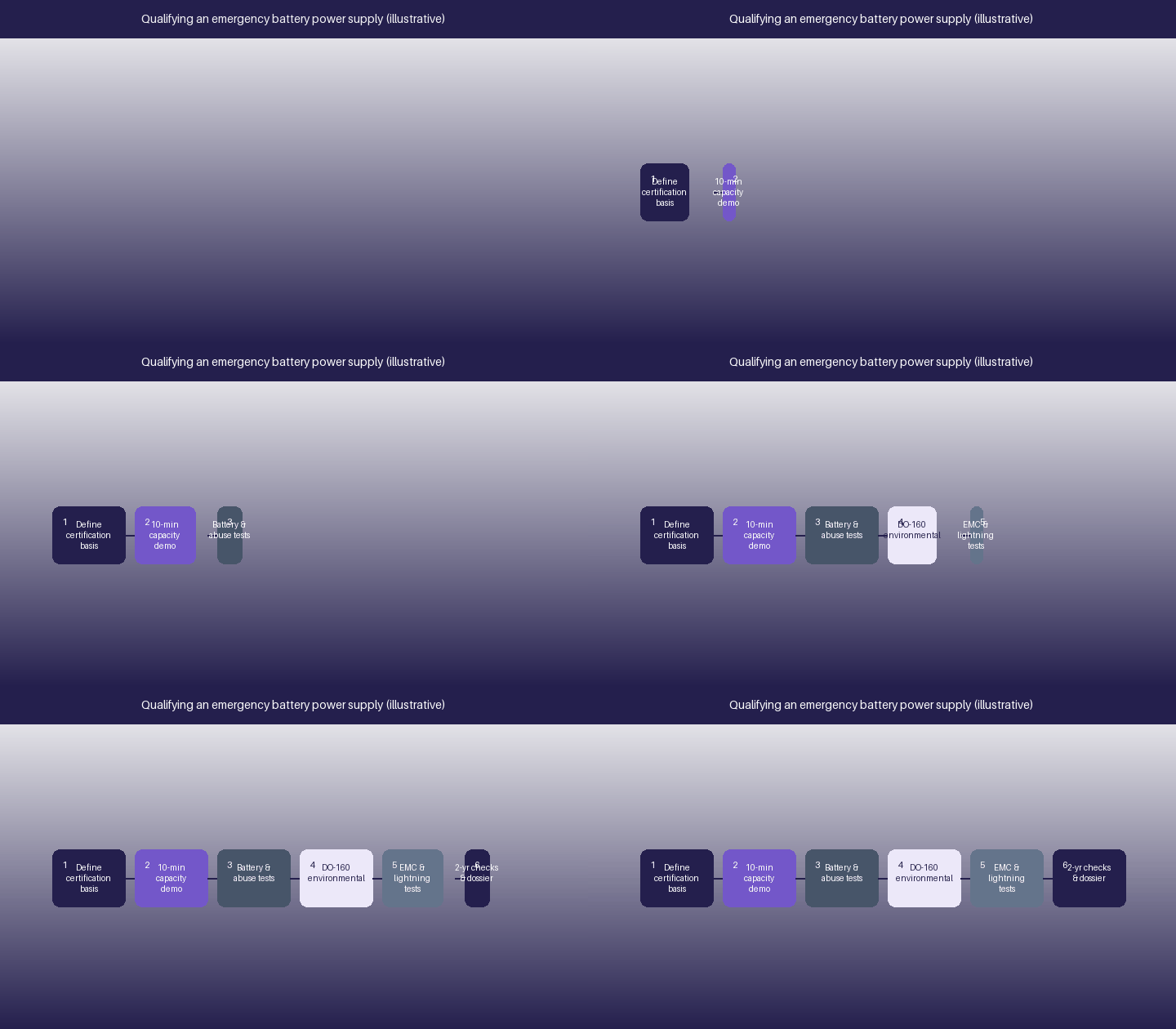
A TSO is an FAA document that prescribes a minimum performance standard for a specified article; a manufacturer whose article meets the TSO and whose production is approved can ship it as a TSO article. For sealed NiMH batteries that order is TSO-C173a, and it does not restate every test from scratch - it invokes an RTCA MOPS, DO-293A, which defines the test conditions, categories and procedures specific to NiMH chemistry. DO-160G then supplies the horizontal rules almost every powered airborne article must meet: the environmental conditions (temperature and altitude, thermal variation, humidity, vibration, shock and crash safety, and the other exposure categories) and the electromagnetic compatibility (EMC) and power-quality procedures. The certified product reflects all three: the True Blue Power TS56 is marked FAA TSO-C173a certified, RTCA DO-293A qualified and RTCA DO-160G qualified. The contrast with certified lithium is instructive and should not be blurred. Rechargeable lithium introduces thermal-runaway behaviour the aqueous chemistries do not, so it is governed by RTCA DO-311 and DO-311A, authorised under TSO-C179 and installed under the guidance of AC 20-184A, with special conditions and extensive cell, module and system-level thermal testing; the 2013 events on the Boeing 787 show why that heavier oversight exists. Sealed NiMH uses an aqueous, non-flammable potassium-hydroxide electrolyte, so it does not exhibit lithium-style thermal runaway and qualifies through the leaner nickel stack. The first animated figure below summarises the full qualification sequence.
The single most important test is not a chemistry experiment but a demonstration of a regulatory floor. Under 14 CFR 25.812(i), the energy supply to each emergency lighting unit must provide the required level of illumination for at least 10 minutes at the critical ambient conditions after an emergency landing. In the laboratory that requirement becomes a defined sequence: the supply is fully charged and conditioned per the procedure, installed with the actual emergency load (or a validated equivalent that reproduces its current and inrush), the configuration is established at the worst-case temperature the installation defines, and the delivered illumination and terminal voltage are recorded from the first second through the required interval. For an aqueous chemistry the critical condition is dominated by cold-soak, which simultaneously lowers the capacity a cell can deliver and raises its internal resistance, deepening the voltage sag under the starting pulse; the demonstration must therefore be run at that cold condition rather than at room temperature, where the pack looks its best. Two discipline points follow, and they mirror Paper B. First, 10 minutes is a pass-or-fail minimum, not a design target; a sound installation shows the floor met with clear margin and, in practice, specifies operational endurance well beyond it - the certified TS56, for example, is rated for on the order of 132 minutes at a 1 A discharge. Second, the supply must clear the equipment low-voltage cut-off for the entire interval, including immediately after the cold starting pulse, because a pack with ample total energy still fails if its bus collapses at the first second. The same regulation supplies the surrounding checks: on, off and armed positions, control from the flight station and a flight attendant station, and a charging circuit that cannot discharge into a fault.
Illustrative 10-minute demonstration sequence (qualitative)
| Step | What is verified |
|---|---|
| 1. Charge and condition | Full charge per procedure; record date and temperature |
| 2. Cold-soak to critical ambient | Stabilise at the worst-case installation temperature |
| 3. Establish emergency load | Reproduce simultaneous loads and the starting inrush |
| 4. Record illumination and voltage | Required illumination for ≥10 min; bus above cut-off |
| Result | Floor met with margin (pass), or redesign and retest (fail) |
Beyond the regulatory demonstration, the MOPS defines a family of tests that characterise the NiMH pack itself and confirm it will remain safe and predictable across its life. The rated-capacity test discharges a fully charged pack at a defined current and compares the delivered ampere-hours with the nameplate, establishing the baseline every later check references. The charge-retention (self-discharge) test stores a charged pack for a defined period and then measures the capacity that remains, which matters acutely for an article that may sit for months between flights. The endurance or cycle-life test repeats charge and discharge through a defined number of cycles and confirms the pack retains capacity within the allowed band rather than fading prematurely. A set of abuse tests then proves the pack fails safely rather than catastrophically: overcharge applies charge beyond full, and the short-circuit test imposes a near-zero-resistance path, while the pack's protection - the TS56, for instance, lists short circuit, over-temperature, under-voltage and over-voltage protection together with EMI filtering - must contain the event. Because the chemistry is aqueous and sealed, these tests establish safety without the propagation analysis lithium requires, but they are not optional. The table below summarises the family; the exact currents, durations and pass limits are those defined in the invoked standard and the manufacturer's procedure, which is why a rigorous article cites the document rather than inventing round thresholds.
| Test | What it proves |
|---|---|
| Rated capacity | Delivered Ah matches nameplate at the defined discharge current |
| Charge retention | Capacity that survives long stowage (self-discharge behaviour) |
| Endurance / cycle life | Capacity retained within the band after defined cycles |
| Overcharge | Pack contains charge beyond full without hazard |
| Short circuit | Protection contains a near-zero-resistance fault |
DO-160G turns the real flight and emergency-landing environment into a set of laboratory condition categories, and the categories applicable to a given article depend on where it is installed. A cabin-mounted emergency supply is qualified across the temperature range it will see in service and through temperature variation cycling, to reduced pressure and the thermal effects of altitude, and to humidity, where long exposure must not degrade the cells or electronics. It is subjected to vibration representative of the airframe and to operational shock; and because the unit must still function after an emergency landing rather than only in normal flight, its mechanical qualification is tied directly to the crash-restraint rules of 14 CFR 25.561. That section specifies the ultimate inertia forces, acting separately, under which equipment and other large masses must be restrained: upward 3.0g, forward 9.0g, sideward 3.0g on the airframe (4.0g on seats and their attachments), downward 6.0g and rearward 1.5g; items that could break loose must be positioned or restrained so they cannot injure occupants, penetrate fuel systems or nullify escape facilities, and local attachments for frequently removed items are designed to a higher margin. The pack's mounting, enclosure and the anodized housing are qualified to these loads so the supply stays attached and connected precisely when the cabin needs it. Additional exposure categories - such as water, fluids, sand and dust, fungus and salt fog - are applied where the installation location warrants, which is why a rear-avionics-bay unit and a cabin unit may carry different category letters even when the pack inside is identical.
An emergency supply is both a potential source and a potential victim of electrical interference, and DO-160G addresses this with a numbered set of procedures that accredited laboratories run. The electrical and EMC sections include magnetic effect (Section 15), power input (16), voltage spike (17), audio-frequency conducted susceptibility on power inputs (18), induced signal susceptibility (19), radio-frequency susceptibility, both radiated and conducted (20), emission of radio-frequency energy (21), lightning-induced transient susceptibility (22), lightning direct effects (23) and electrostatic discharge (25). The logic is twofold. On the emission side, the pack and its charge electronics must not radiate or conduct interference that disturbs nearby avionics or radios. On the susceptibility and power-quality side, the unit must continue to function when the aircraft bus presents voltage spikes, ripple, induced transients and RF fields, and must ride through lightning-related transients without dropping the essential load or being damaged. Because the supply is maintained at readiness from the very bus it backs up - the TS56 accepts a 20-30 VDC input - the power-input tests confirm that a disturbance on that charging network neither forces a false discharge nor leaves the pack undercharged. These tests are performed in shielded enclosures and anechoic chambers with defined levels, and the resulting category designations are recorded in the qualification report rather than asserted generically.
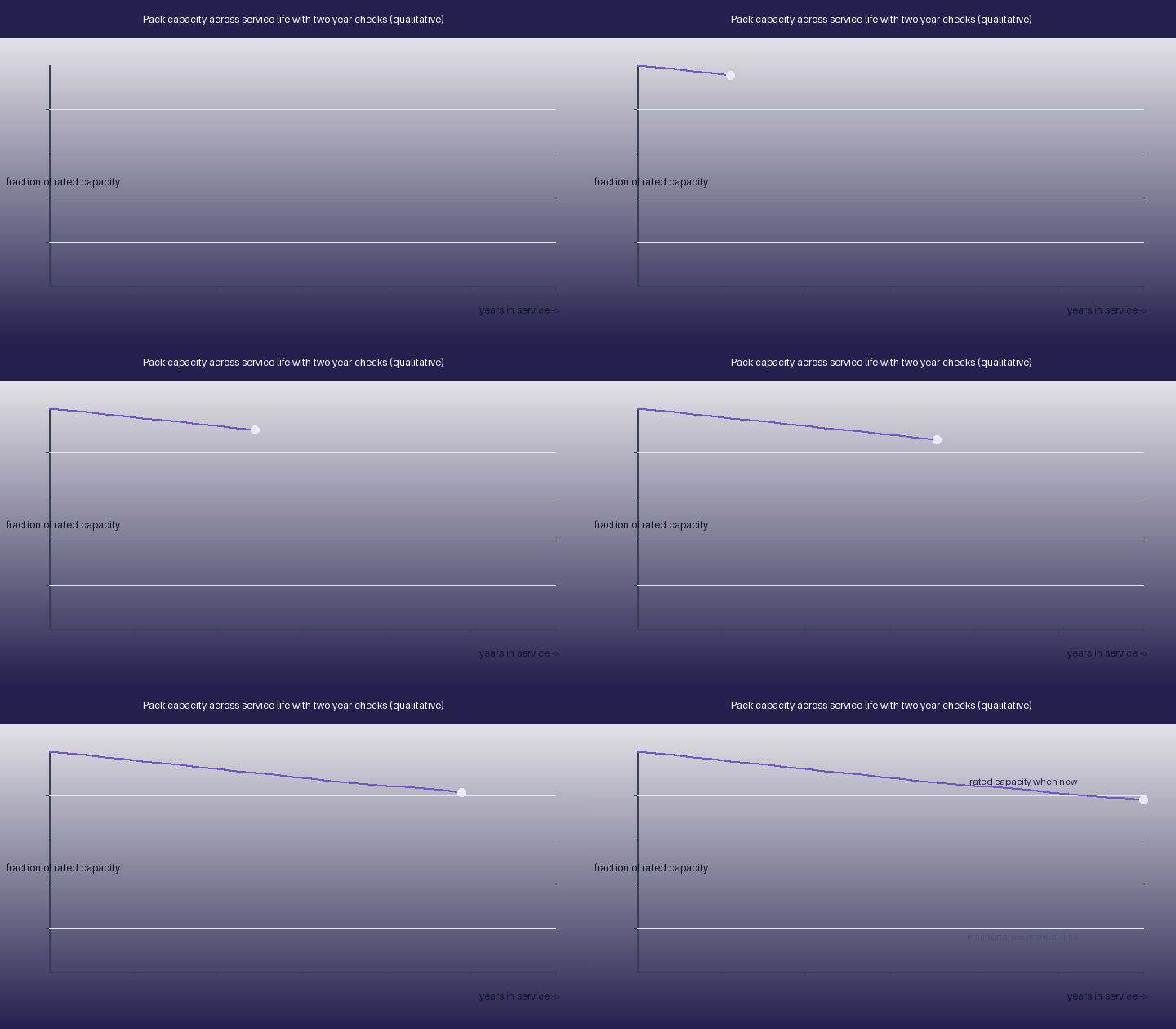
Qualification gets a pack onto the aircraft; the maintenance program keeps it legal and reliable across its service life, and here the chemistry choice has direct commercial weight. Vented NiCad units call for water top-up, cell balancing and frequent deep capacity checks; certified on-condition lithium is marketed as eliminating scheduled deep cycling and regular capacity checks through built-in monitoring. The sealed NiMH emergency-supply class sits between, with a defined capacity-check interval of two years and a stated battery life expectancy on the order of 6-8 years. The recurring check follows a controlled procedure: the pack is fully charged using the approved charge profile, then discharged at the defined current while delivered capacity (or the endurance into the emergency load) is measured and compared with the limit in the manufacturer's maintenance manual; a pack that meets the limit is returned to service, and one that has faded below it is removed for cell replacement or overhaul. The record - date, temperature, measured capacity and the technician's sign-off - is retained so the airworthiness history is traceable. The second animated figure above plots this logic qualitatively: capacity fades gradually over service years, the two-year checks confirm the pack remains above the maintenance-manual limit, and removal is triggered only when a check crosses that limit. Defining the exact numeric pass threshold is the role of the approved manual, which is why the figure is labelled qualitative rather than assigning a universal percentage.
Two supporting elements complete the qualification picture. First, transport and cell-level standards. Because the pack is NiMH rather than lithium, it sits outside the lithium-battery transport regime - the lithium-specific test summary, state-of-charge limits and related shipping restrictions do not apply - which materially simplifies moving spare packs to line stations and operator depots; the underlying sealed cells are characterised against the established nickel standards such as IEC 61951-2 for portable sealed NiMH cells and IEC 62133-1 for safety of cells containing alkaline or other non-acid electrolytes. Second, the article is delivered with a traceable dossier rather than an unsupported claim: the TSO/DO-293A capacity and abuse results, the DO-160G environmental and EMC category report, a pack drawing showing the series cell count, welded tabs, venting and thermal protection, the charge-control specification, the crash-restraint analysis for the mounting, and a chemistry and transport statement. It is that combination - demonstrated regulatory floor, qualified enclosure, a two-year maintenance rhythm and a defensible evidence file - that turns a tested pack into one an OEM, completion centre or operator can actually install and keep flying.
Weijiang Power manufactures sealed nickel-metal hydride cells and matched industrial packs for emergency lighting and critical-equipment power supplies, alongside a broad range of industrial NiMH packs for aviation, transport, marine and medical equipment, and supplies OEM and operator partners with a complete evidence file: cell performance reports, nickel-system safety and abuse results, high-rate and cold-temperature characterisation, welded-tab pack drawings showing venting and thermal protection, charge-control co-validation, crash-restraint analysis and a clear non-lithium transport statement. Send us your emergency load list and the critical ambient conditions, the sustained current and starting pulse, the installed temperature and altitude envelope and the standards the unit must meet, and our engineers will run the capacity demonstration, qualify the pack to the environmental and EMC conditions and define the recurring capacity-check program for a form-fit unit that stays at full readiness through years of service. Review the cell and pack range on the products page.


